The High Energy Physics Research Computing Group at the University of Victoria is actively in the development of computing, storage and network projects for the ATLAS experiment at the CERN Laboratory (Switzerland) and the Belle II Experiment at the KEK Laboratory (Japan). We also manage HEPNET/Canada, which is reponsible for the national and international network connectivity for the Canadian particle physics community http://www.hepnetcanada.ca.
University of Victoria | |
| Randall Sobie | IPP Research Scientist (Group Leader) |
| Colson Driemel | Cloud Developer |
| Marcus Ebert | Computational physicist |
| Tristan Sullivan | HEPNET/Canada |
Using Microsoft Azure cloud for High Energy Physics
UVic using Azure (2017)
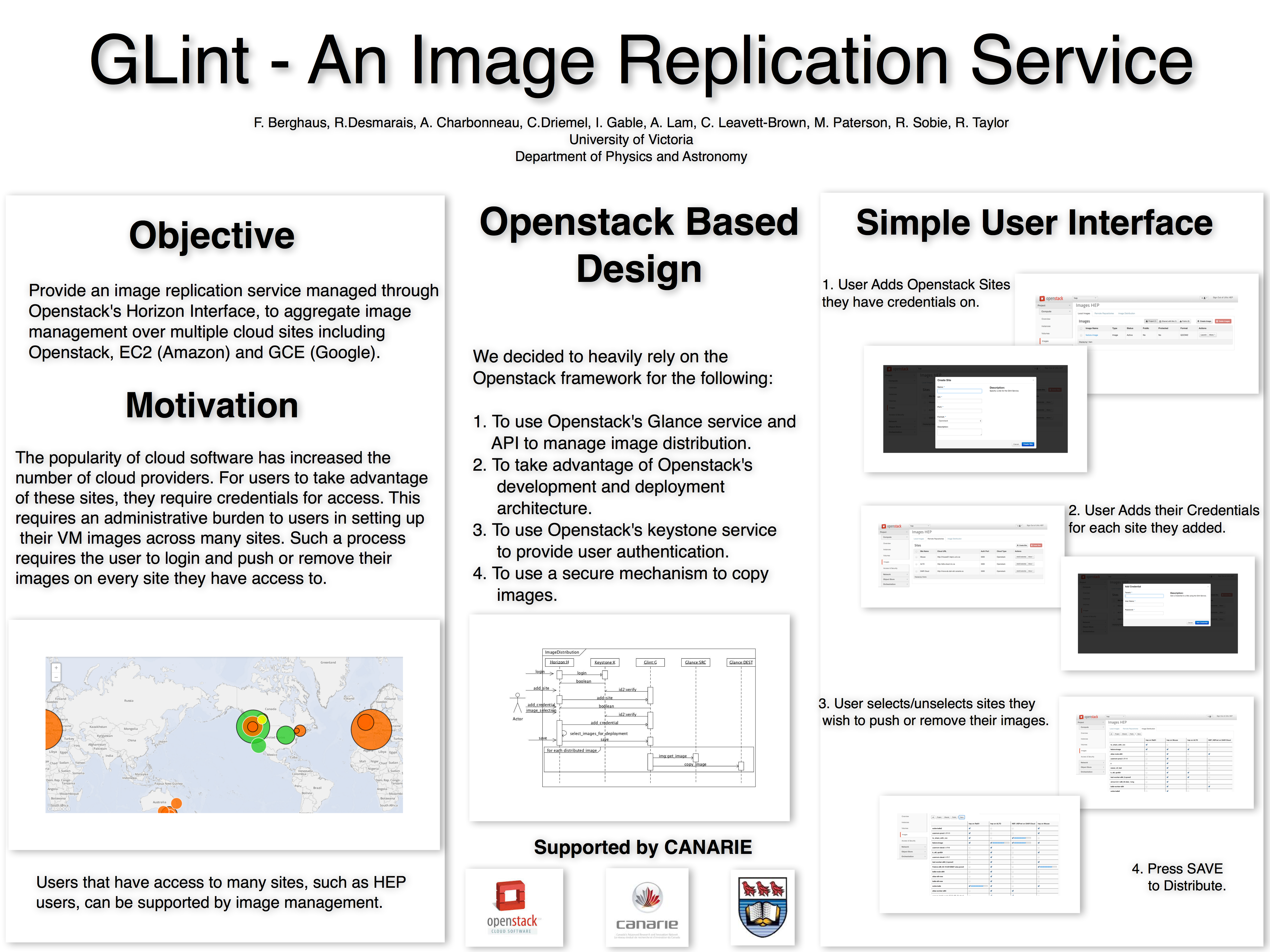
Glnt VM Image Repository
C.Leavett-Brown, OpenStack Summit Paris 2014
OpenStack User Stories
R.Sobie 2014
Clouds in High Energy Physics
R.Sobie Keynote Presentation, OpenStack Summit Portland 2013
SC12 HEP data disk-to-disk
SuperComputing 2012 Conference video
High Energy Physics Data at 100 Gb/s
SuperComputing 2011 Conference video
The BaBar Detector at SLAC
H.Leavett-Brown animation of BaBar experiment 2010
Open-source code tracks data’s international travels UVic News February 2026
Canadian Particle Physics Team Achieves First Terabit-Per-Second Data Transfer from a Canadian University to the SC25 Supercomputing Conference BCNET News Item, November 20, 2025
GEANT Connect December 2025
CANARIE Network Quadruples Capacity for Research and Education Data to 397 Gigabits per second CANARIE News Item, January 10, 2025
$16.4M reboot elevates cloud computing performance and energy efficiency UVic News June 5 2024
Rebuilding a plane while it’s still flying: UVic supercomputer to get $16.4M overhaul Times Colonist June 6 2024
UVic receives $16.4M for supercomputer infrastructure upgrade Victoria News June 6 2024
The Alliance awards $50M+ to Simon Fraser University and the University of Victoria to renew advanced research computing infrastructure Digital Research Alliiance of Canada News June 3 2024
Alliance 2020-2021 Annual Report Researcher Profiles
NDRIO’s Researcher Council Elects New Chair, Dr. Randall Sobie NDRIO News March 2021
CFI Award for the Belle II Raw Data Centre UVIC News March 2021
Canada’s New Digital Research Infrastructure Organization Names Inaugural Researcher Council NDRIO 2020
A data system for the world’s largest physics experiment UVic Ring 2016 and BC Technology 2016
The Fast Path to International Research Collaboration, Brocade 2015
HEP Data-Intensive Distributed Cloud Computing System CANARIE 2015
SanDisk Helps Accelerate HEP Research for the Origin of the Universe SanDisk Media release 2014
Canadian physicists achieve 100G transatlantic transmission CANARIE 2014
CANARIE invests in 9 innovative software projects CANARIE 2014
Team demonstrates intercontinental OpenFlow network at Super Computing (BCNET 2013)
Enterprises launch their own private clouds CNN Money 2013
Physicists link OpenStack, Nimbus clouds around the world to share resources IT World 2013
Moving at the speed of data UVIC Internal 2013)
High-Energy Physicists Smash Records for Network Data Transfer 2012 Caltech News
Particle physicists use fast network to find the Higgs boson CANARIE 2012
Data goes faster than ever CERN 2012
High-Energy Physicists Set Record for Network Data Transfer BBC and NPR and Ciena
Preserving research data to enable long-term investigation and discovery, CANARIE 2011
Canada Explores New Frontiers in Astroinformatics, HPC in the Cloud 2011
UVic research data transfer = 132 million books, UVIC Ring December 2010
Cloud computing at UVIC, CANARIE 2010
UVIC establishes compute cloud for particle physics, UVIC Vice-President Research Newsletter
Preserving the Data Harvest, Symmetry Magazine, December 2009
Researchers Collaborate to Sustain Canada’s Forests, BCNET 2009
$1.55 Million Funds Data Preservation, UVIC Media Release 2009
CANARIE Invests Millions More in Cutting-edge Canadian Research, CANARIE 2009
Technology Brings Scientists Together Oak Bay and Sannich News 2008
WestGrid linked to Nobel Prize in Physics, WestGrid News, 2008
BCNET Faculty Recognition Award, BCNET 2008
Building a high-speed network for High Energy Physics, UVic 2008
CANARIE Announces Network Enabled Platform (NEP) Projects, CANARIE 2008
BCs Big Science Projects get on Board to Use New Supercharged ROADM Network, BCNET 2007
ATLAS: Huge Data Needs Huge Bandwidth, BCNET 2007
The Power of Grid Computing, UVic 2006
Canadian grid computing project finds place in ATLAS, ITBusiness 2005
Creating the World’s Largest Computer Grid BCNET 2005
GridX1 project joins LHC Computing Grid, CERN Courier 2005
Grid project probes our origins, IT World Canada 2005
UVic Helps Form World’s Largest International Computer Grid, Grid Today article 2005
Dan Vanderster : UVic graduate student wins BCNet coolest application contest BCNET 2004
Dan Vanderster : IEEE Gold Medal in Computer Engineering UVIC 2003
Girding for the Grid, UVIC 2003
Research Report at the 2026 IPP Annual General Meeting
R.Sobie, IPP AGM 2026 Ottawa
Computing Infrastructure Conference Summary
M.Ebert CHEP 2026 Bangkok
Status and future of the BaBar Long Term Data Preservation and Computing Infrastructure
CHEP 2026 Bangkok
Performance optimisations for a cloud-based grid site
CHEP 2026 Bangkok
Update on the Canadian Belle II Tier1 Raw Data Centre
CHEP 2026 Bangkok
Scitags at Scale: Terabit Packet Marking and WLCG Data Challenge Readiness
CHEP 2026 Bangkok
SciTags demo at Super Computing 2025
LHCONE and LHCOPN Meeting, April 2026 (Montreal)
A cloud-based grid computing site
Australian E-Research Meeting, October 2025
BaBar Data Preservation
M.Ebert, RHIC Data Preservation Meeting, May 2025
SuperComputing Network Tagging Demo
T.Sullivan, LHCOPN and LHCONE meeting, Manchester, March 2025
DC24 High-Touch Data Analysis
T.Sullivan, LHCOPN and LHCONE meeting, Manchester, March 2025
SuperComputing Network Tagging Demo poster
T.Sullivan, SuperComputering Conference, Atlanta 2024
DC24 High-Touch Data Analysis
T.Sullivan,LHCONE Meeting Beijing October 2024
SuperComputing 2024 Scitags Demo Project
T.Sullivan,LHCONE Meeting Beijing October 2024
An implementation of cloud-based grid CE and SE for ATLAS and Belle II
2024 Conference on Computing in High Energy and Nuclear Physics (Krakow)
Canadian Belle-II Tier1 Raw Data Centre
M.Ebert, CHEP 2024 (Krakow)
The BaBar Long Term Data Preservation and Computing Infrastructure
M.Ebert, CHEP 2024 (Krakow)
Using S3 storage with xrootd vs Dynafed
M.Ebert, CHEP 2024 (Krakow)
Scitags: A Standardized Framework for Traffic Identification and Network Visibility in Data-Intensive Research Infrastructures
2024 Conference on Computing in High Energy and Nuclear Physics (Krakow)
Scitags: An Initiative to Improve R&E Networking Visibility
T.Sullivan BCNET Connect Conference, April 2024
Data Preservation and Open Data at the B-Factories
M.Ebert SLAC FlavorSymposium April 2024
The BaBar Long Term Data Analysis facility
M.Ebert HEPIX 2023 Workshop, Victoria, October 2023
Managing remote cloud resources for multiple HEP VO’s with cloudscheduler
M.Ebert CHEP 2023 Conference, Norfolk, May 2023
BaBar’s Experience with the Preservation of Data and Analysis Capabilities
M.Ebert CHEP 2023 Conference, Norfolk, May 2023
HEPscore: a new benchmark for WLCG compute resources
R.Sobie CHEP 2023 Conference, Norfolk, May 2023
Identifying and Understanding Scientific Network Flows
CHEP 2023 Conference, Norfolk, May 2023
Cloud based Tier 2 Computing at the University of Melbourne
D.Dossett, M.Sevior, M.Ebert, Asian Forum for Accelerators and Detectors Melbourne April 2023
Creating a Grid Storage Element Using S3-compatible Object Storage and Dynamic Federation at the University of Melbourne
CHEP 2023 Conference, Norfolk, May 2023
HEPscore: a new benchmark for the WLCG
R.Sobie, HEPiX Workshop, Taipei March 2023
Cloudscheduler V.2 from an HTCondor admin's point of view
M.Ebert, HEPiX Workshop, Taipei M
arch 2023
Job Accounting for HTCondor with Heterogeneous Systems
M.Ebert, HEPiX Workshop, Taipei M
arch 2023
HEPScore – a new CPU benchmark for the WLCG
R.Sobie , WLCG Workshop Lancaster 2022
Preservation of Data and Analysis Capability at BaBar
M.Ebert, Belle II Data Preservation Workshop Oct 7 2022
Meeting the digital infrastructure needs of the Canadian Research Community
R.Sobie and N.Ladak, BCNET 2022
Shoal a squid cache publishing and advertising tool
M.Ebert, HEPiX 2021
Belle II Benchmarks
T.Sullivan, HEPiX Benchmarking Working Group, Nov 2020
Update on the Digital Research Infrastructure in Canada
R.Sobie, IPP AGM 2020
Kubernetes as an ATLAS computing site
D.MacDonell, Pre-GDB meeting on containers, CERN, December 2019
ATLAS Sim@P1 upgrades during long shutdown two
F.Berghaus, CHEP 2019, Adelaide, ATL-COM-SOFT-2019-086
Using Kubernetes as an ATLAS Computing Site
CHEP 2019, Adelaide, ATL-SOFT-SLIDE-2019-782
Cloudscheduler V2, distributed cloud computing
R.Sobie CHEP 2019, Adelaide
The Dynafed data federator as grid site storage element
F.Berghaus et al, CHEP 2019, Adelaide
Analysing perfSonar data with Elasticsearch
R.Seuster, HEPiX 2019, Amsterdam
Using Dynafed with clouds for ATLAS and Belle II
F.Berghaus Pre-GDB Workshop on Dynafed July 2019 CERN
Digital Research Infrastructure in Canada
R.Sobie IPP AGM 2019
Cloudscheduler V2
F.Berghaus Cernvm Workshop CERN
Container clusters for particle physics applications
D.MacDonell Matrix Institute Workshop Victoria
Network Technology Watch Update
Seuster and Martelli, HSF-WLCG Workshop, Norfold 2019
Using the Dynafed dynamic federator as a Rucio Storage Element
F.Berghaus Rucio Workshop Oslo
Update of the Canadian T1 and T2 Facilities
R.Seuster, HEPiX San Diego 2019
Cloudscheduler Version 2
R.Seuster, HEPiX San Diego 2019
Using Dynafed data federation as a site Storage Element
M.Ebert, HEPiX San Diego 2019
Cloud Usage for Workloads in High Energy Physics
M.Ebert, ComputeCanada Cloud External Relationship Development Meeting
Cloud Usage for Workloads in High Energy Physics: Utilizing Distributed Clouds for Compute and Storage
M.Ebert, Openstack Summit, Vancouver 2018
Using a dynamic data federation for running Belle-II simulation applications in a distributed cloud environment
M.Ebert, CHEP 2018 Sofia
Integrating a dynamic data federation into the ATLAS distributed data management system
F.Berghaus, CHEP 2018 Sofia
Quasi-online accounting and monitoring system for distributed clouds
R.Seuster, CHEP 2018 Sofia
Sim@P1: Using Cloudscheduler for offline processing on the ATLAS HLT farm
F.Berghaus, CHEP 2018 Sofia
Running HEP workloads in distributed clouds
R.Seuster, HEPiX KEK 2017
Cloud storage with the Dynafed data federation
M.Ebert, HEPiX KEK 2017
Federating distributed storage for clouds in ATLAS
F.Berghaus ACAT Seattle 2017
Exploiting clouds and data federations for HEP
R.Sobie HPCS Kingston 2017
Networks in Canadian HEP
R.Sobie IPP AGM Kingston 2017
Clouds in HEP
R.Sobie Plenary talk CHEP San Fransisco 2016
Context-aware distributed cloud computing using CloudScheduler
R.Seuster CHEP San Fransisco 2016
Enabling Research Network Connectivity to Clouds with Virtual Router Technology
R.Seuster Poster CHEP 2016
Consolidation of Cloud Computing in ATLAS
R.Taylor Poster CHEP San Fransisco 2016
Cloud Computing at Tier-2 Sites
R.Sobie WLCG Workshop San Fransisco 2016
Summary of Track on Middleware, Monitoring and Accounting
R.Sobie Plenary talk CHEP San Fransisco 2016
Cloud computing for HEP applications
R.Sobie, HPCS Edmonton 2016
Context-aware cloud computing for HEP
R.Sobie, ISGC Taipei 2016
Federating clouds for HEP
I.Gable, OpenStack Summit, Vancouver 2015
The evolution of cloud computing in ATLAS
R.Taylor, CHEP 2015 Okinawa
HEP production using the HTCondor/CloudScheduler architecture
I.Gable, CHEP 2015 Okinawa
Utilizing cloud computing resources for Belle-II
R.Sobie, CHEP 2015 Okinawa
Glint: VM image distribution in a multi-cloud OpenStack environment
Poster CHEP 2015 Okinawa
Glint: image distribution in a multi-cloud environment
C.Leavett-Brown, OpenStack Summit, Paris 2014
HEP Computing in a Context-aware Distributed Cloud
R.Sobie, DCC Workshop, Chicago 2014
Glint Image Repository
R.Desmarais, Poster SAVI Workshop, Toronto 2014
HEP Computing in a Context-aware Distributed Cloud
R.Sobie, Science Cloud Workshop, Vancouver 2014
Big data in HEP
R.Sobie, BCNET 2014
Status of the Canadian LHCONE Network
I.Gable, LHCONE Meeting, CERN 2014
HTC computing in a distributed compute cloud
R.Sobie, Science Cloud Workshop, New York 2013
Distributed IaaS Clouds and 100G Networking for HEP applications
I.Gable, HPCS 2013, Ottawa
Clouds in High Energy Physics
R.Sobie, OpenStack Summit 2013, Portland
Adding IaaS Clouds to the ATLAS Computing Grid
R.Taylor, Int Science Grid Conference Taipei 2013
Data intensive HEP analysis in a distributed cloud
A.Charbonneau, HPCS Montreal 2011
Operating a distributed IaaS cloud for BaBar
I.Gable, HEPiX Conference, Darmstadt 2011
Cloud computing for research
R.Sobie, BCNET 2011
Clouds for research computing
R.Sobie, Canada-EU Internet Workshop, Waterloo 2011
Repoman: a simple RESTful X.509 Virtual Machine Image Repository
R. Impey ISGC Taipei 2011
Simulation and user analysis of BaBar data in a distributed cloud
C.Leavett-Brown ISGC Taipei 2011
Research Computing in a distributed cloud environment
K.Fransham, HPCS 2010, Toronto
Sky’s the Limit
C.Leavett Brown, BCNET 2010
An Adaptive Batch Environment for Clouds
I.Gable, HEPiX Spring 2010, Lisbon
Cloud Scheduler
P.Armstrong, Globus World, Argonne National Laboratory 2010
Frank Berghaus
Kevin Casteels
Micheal Paterson
Ian Gable
Ron Desmarais
Chris Tooley
Ashok Agarwal
Kyle Fransham
Colin Leavett-Brown
Marcus Lee
Catherine Meng
Rolf Seuster
Matt Vliet
Duncan Penfold-Brown
Daniel Vanderster
Valeria Gomez (Winter 2026)
Sejion Lee (Fall 2025)
Payne Jones (Winter 2025)
Travis Lee (Fall 2024)
Alyssa Blair (Fall 2023)
Cindy Ng (Fall 2022)
Victor Kamel (Fall 2021 and Summer 2022)
Kathryn Dolby (Summer 2021)
Garet Robertson (Winter 2020)
Matthew Ens (Fall 2019)
Shaelyn Tolkamp (Winter 2019)
Tayha Weiss-Gibbons (Fall 2017 and Winter 2018)
Jodie Weldon (Winter 2017 and Fall 2018)
Trevor Lee (Fall 2016)
Darryl Ring (Winter 2016)
Matthew Murray (Summer 2015)
Martin Conklin (Winter and Summer 2015)
Colson Driemel (Summer 2014 and Winter 2015)
Alex Lam (Winter 2014)
Robert Prior (Fall 2013)
Michael Chester (Winter 2013)
Pranav Shrestha (Winter 2012)
Andrey Polyakov (Fall 2011)
Tubego Phamphang (Fall 2011)
Robert Rusnak (Summer 2011)
Tony Bashi (Winter 2011)
Brennan McKinney (Winter 2011)
Drew Harris (Fall 2010)
Michael Anderson (Fall 2010)
Holly Leavett-Brown (2010-2012)
Matt Vliet (Winter 2009 and Summer 2010)
Adam Bishop (Summer 2009 and Winter 2010)
Michael Paterson (Summer and Fall 2008, Fall 2009, Winter 2010)
Vikram Sandhu (Fall 2009)
Chris Usher (Winter 2006, Summer 2009)
Cole Uhlmanm (Summer and Fall 2008)
David Bartle (Winter 2008)
David Grundy (Winter 2008)
Sean Manning (Winter 2008)
David Gong (Fall 2007)
Sydney Schaffer (Summer 2007)
Cameron Sobie (Summer 2007)
Tristan Sullivan (Winter 2007)
Duncan Penfold-Brown (Winter 2007)
Sergey Popov (Fall 2006)
Simon Ramage (Summer 2006)
Patrick Armstrong (Summer 2006)
Avery Berman (Winter 2006)
Angela Norton (Fall 2005, Fall 2006)
Ron Desmarais (Summer 2005)
Marco Yuen (Winter 2005)
Quinn Matthews (Fall 2004)
Clayton Lindsay (Summer 2004)
Alexandro Dimopoulos (Winter 2004)
Lila Klektau (Fall 2003, Summer 2004)
Manjinder Benning (Winter 2003)
Jenny Allan (Winter 2003)
Dan Vandrster (Fall 2002)
Ian Zwiers (Summer 2002)
Graeme Smetcher (Winter 2002)
Randall Sobie
Institute of Particle Physics Research Scientist
Director, Victoria Subatomic Physics and Accelerator Research Centre (VISPA)
University of Victoria
Elliott Building Room 205B
Telephone (250) 721-7733
Email rsobie at uvic.ca
Mailing Address
Department of Physics and Astronomy, University of Victoria
P.O. Box 3055 STN CSC, Victoria, BC, Canada V8W 2Y2
Courier Address
Department of Physics and Astronomy, University of Victoria
Elliott Building, Room 101, 3800 Finnerty Road, Victoria, BC, Canada V8P 5C2